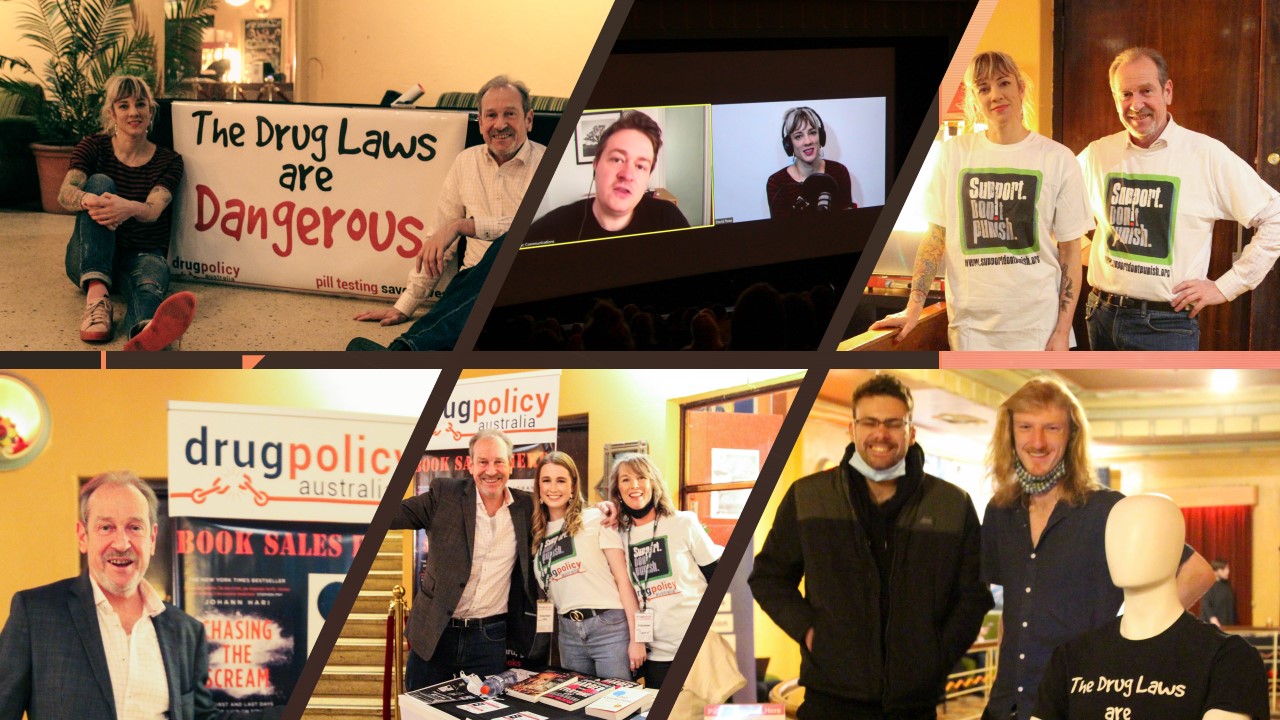
This will be my final blog post and intends to reflect more generally on my time at DPA having now completed my 40-day placement. The ‘Support. Don’t Punish’ (SDP) is a global campaign which is centred around advocating for international and domestic drug policies to reflect human rights and health-oriented approaches to drug-related social problems. The annual Global Day of Action for the SDP campaign is June 26, and Drug Policy Australia (DPA) is the instrumental organising force rallying behind the campaign in Australia. This year, DPA organised a public screening of the recently released film ‘The United States vs Billie Holiday’ at the Astor Theatre in St Kilda. Helping organise this event was a powerful learning experience for me, not just in understanding the mechanics of organising/advocacy, but also on a personally emotional level.
The Event
Here is the event description which I drafted for the DPA website and ticketing page:
“Join Drug Policy Australia for a film screening of The United States vs. Billie Holiday at The Astor Theatre in St. Kilda on Support Don’t Punish Day, Saturday 26 June 2021.
This amazing biography delves into the beginning of the criminalisation of people who use drugs in America based on the New York Times Best Selling book, Chasing the Scream by internationally acclaimed writer Johann Hari.
Johann Hari will appear live from London to introduce the movie and talk about the amazing back story of Billie Holiday and her battle with Harry Aslinger, the newly appointed head of the Federal Bureau of Narcotics. He will be talking with Jenny Valentish, a journalist and author of ‘Woman of Substances: A Journey into Addiction and Treatment’, where she explores the unique experiences of women with alcohol and drugs.
After a short intermission, we will show the movie at 8:00 O’clock, which provides a fascinating look at Billie Holiday’s illustrious career as a legendary jazz singer as she battled addiction, racism and was targeted by the FBI through an undercover sting operation in an effort to silence her.
On Saturday, 26th of June, more than 150 cities across the world will take part in the global advocacy campaign ‘Support. Don’t Punish’, calling on governments to enact drug policies that prioritise public health, human rights, and provide greater access to harm reduction interventions.
There will be information tables from Australia’s leading Alcohol and Other Drugs NGO’s” (DPA Website).
How I Participated
As was the case with the majority of my work at DPA, the event was organised by myself and the Managing Director, Greg Chipp. The screening of the film served multiple purposes including: fundraising, promoting the SDP messaging, furthering the community recognition of DPA and raising community awareness about local and international issues relating to substance use. Organising this event was particularly challenging given that all aspects of the event organisation were conducted by no more than three people for the duration while also having to contend with the changing venue capacities and mobility restrictions as the dynamics COVID-19 were changing on a daily basis. Additionally, this was DPAs seminal annual fundraising event with an originally defined ideal number of attendees being approximately 700-800.
I was largely responsible for social media communications, drafting emails, keeping record of communications with participating external organisations, drafting emails for volunteers, stakeholders and the general membership of DPA as well as kee;ping a record of ticket sales and leading a team of volunteers on the night. A key learning I took out of this experience was the value of just doing one thing at a time, particularly on the night when the pressure was higher and the chain of events was unpredictable. As a leader on the night, the volunteers were learning their roles and tasks and I was responsible for explaining their roles as well as helping with technical difficulties – particularly with the merchandise sales teams who were responsible for electronic sales – and follow up questions. As is often the case with events, the technology proved troublesome, particularly setting up the ‘Square’ electronic payment processing facilities. I regularly had crowds of people asking me questions and often being quite insistent despite the chaos as patrons started entering the Astor. Accepting that I could only answer one question at a time and that I could not help everyone at a given moment was crucial. Not only did this prevent me from getting flustered and overwhelmed – which has been a historic weakness of mine – but it meant that since I was putting all of my energy to one task at a time, I was able to perform each task at a higher level. This seems intuitive, however in those pressured situations, it can be very difficult to keep focus and just play each situation as it presents itself.
Outcomes
The event was always in doubt as to whether it would actually go ahead or not, and even if it did, we were uncertain as to how many attendees we were actually allowed to have on the premises. Until two days out from the event all of these facts remained uncertain as the government responded to the changing situation. However, we were eventually permitted a maximum attendance of 600 people, which was just about the best situation we could have hoped for.
600 people attended on the night and the reception to the film and live video interview with Johann Hari was one of the more special experiences I’ve been a part of. I met a lot of incredible people and had some of the most absorbing conversations with volunteers, patrons and friends who attended the event. After the film screening, the people I spoke to made had these reflections about the event: ‘I knew that drugs were an issue in society, but I didn’t realise just how pervasive the problem is and just how unjust the War on Drugs has been.’ The issue of drugs in society has been a passion of mine for many years, so hearing the genuine passion and intrigue autonomously resonating from the event attendees was truly rewarding. To have played an instrumental role in organising an event which emotionally charged a 600 people to engage with a social cause gave me genuine pause. I would have to stop and just appreciate what was happening in front of me sporadically through out the evening. These were truly life-affirming moments that I will never forget.
During the pack up, I had some more terrific conversations with people and particularly with the volunteers. However, it was after driving the merchandise, paraphernalia and other equipment back to Greg’s house where I got to take a pause and appreciate what we had achieved. Greg and I were beginning to take stock of the inventory and take count of the revenue and just discussing the strengths of the event and what we can learn for next time. These are rare moments where you’re exhausted after months of effort, commitment, emotion and passion have been pumped into something and you get to sit in your pride and satisfaction for a brief moment and share that with another person. During my time at DPA, Greg and I cultivated a working relationship which was unique to that of your usual employee/employer relationship. Greg would share stories from his past and his personal, professional political experiences and insights with me along the journey. Greg also gave me the space to be honest about the wider dynamics of my social life and helped me work through a time in my life which was emotionally turbulent and challenging for me. In this sense, Greg was more than just an industry supervisor, but also a trusted confidante and emotional support.
The conversation made me realise that the distinction between the personal and professional is so arbitrary and that the true value of your work lies not just in the material outputs of your labour, but also in its capacity to provide meaning and emotional fulfilment. To kick back after the event with Greg after a big semester for me which included finishing my course work in an advanced degree, influencing thousands of people about an issue that I think is important, learnt invaluable life lessons about myself and the nature of social life more generally, is a moment that is etched into my memory. Reflecting on my time working alongside Greg at DPA fills me with a warm nostalgia not just because I am proud of what we achieved through the semester, but because of the relationships I formed, the working ethos of Greg and DPA and the authentic lineage between the community and the organisation. I often find myself confused about what I want to do with my life, and the types of activities I want to participate in. It always seems as though the more I try to understand, the more knowledge and ideas that I am exposed to, the more I realise that I need to learn. However, this experience demonstrated to me just how much agency I have, the kinds of differences I can make and the innate values of my contributions. I feel like I am closer to understanding how meaningful social transformation occurs, and the distinct qualities I can contribute in those spaces. I feel like it need not be said, but thank you, particularly to Greg, but also to all those involved in the process, for providing me with this opportunity. It was truly life changing and prepared me well for the next challenge life throws my way!
 Nick Virgo - International Development Research Project Blog